
OSHA machine guarding requirements: What you need to know
OSHA requires machine guards to protect workers from the point of operation, nip points, rotating parts, flying chips, and sparks. Guards must be secure, tamper-resistant, and positioned so operators can still see and do their work. The four basic types are fixed, interlocking, adjustable, and self-adjusting.
Violations of 29 CFR 1910, Subpart O, Machinery and Machine Guarding, are among OSHA’s most frequently cited regulations every year. Machine guarding (1910.212) landed at No. 10 on OSHA’s final Top 10 list for fiscal year 2026, with 1,498 violations. For 2026, the maximum penalty is $16,550 per serious violation and $165,514 per willful or repeated violation, and because penalties are assessed per violation, a single walkthrough can generate several.
Providing guards for machines is a requirement, not a judgment call. OSHA states that machine guarding shall be provided against hazards such as those created by the point of operation, ingoing nip points, rotating parts, flying chips, and sparks, and guards must protect machine operators and everyone else in the area.
Why does machine guarding deserve priority attention?
The human cost explains the enforcement attention. OSHA reports that approximately half of all amputations occur in the manufacturing sector, with the remainder spread across construction, wholesale trade, retail trade, and services, and that stationary and portable machinery is the primary cause.
Bureau of Labor Statistics data shows the same pattern. In 2018, machinery was involved in 58 percent of work-related amputations, accounting for 3,580 cases. Workers who suffered amputations took a median of 31 days away from work to recover, compared with nine days for all injury types. Machinery used for metal, woodworking, or special materials alone accounted for 1,660 amputations that year.
These are injuries workers carry for the rest of their lives. That reality is what makes guarding worth the attention of your whole organization, from the maintenance crew to the plant manager.
What are the four types of machine guards?
Guards provide physical barriers that prevent access to hazardous areas. They must be secure and strong, and workers should not be able to bypass, remove, or tamper with them. Guards should allow operators a clear view and let employees do their work. There are basically four kinds of guards:
- Fixed. Includes fences, gates, and protective covers for blades, presses, and all moving parts
- Interlocking. Disengages the machine’s power source when opened or removed
- Adjustable. Provides a barrier that can be adjusted to many different operations
- Self-adjusting. These barriers move according to the size or position of the work piece
Guards are one part of a broader safeguarding approach. Where a physical barrier would interfere with the work, safeguarding devices can control the hazard instead: presence-sensing devices that stop the machine when someone enters the danger zone, two-hand controls that keep an operator’s hands occupied during the hazardous cycle, and restraint or pullback devices that keep hands clear of the point of operation. Location and distance can also safeguard a machine when a hazard is positioned beyond normal reach. Matching the method to the machine and the task is where strong programs separate themselves from compliant ones.
How does lockout/tagout relate to machine guarding?
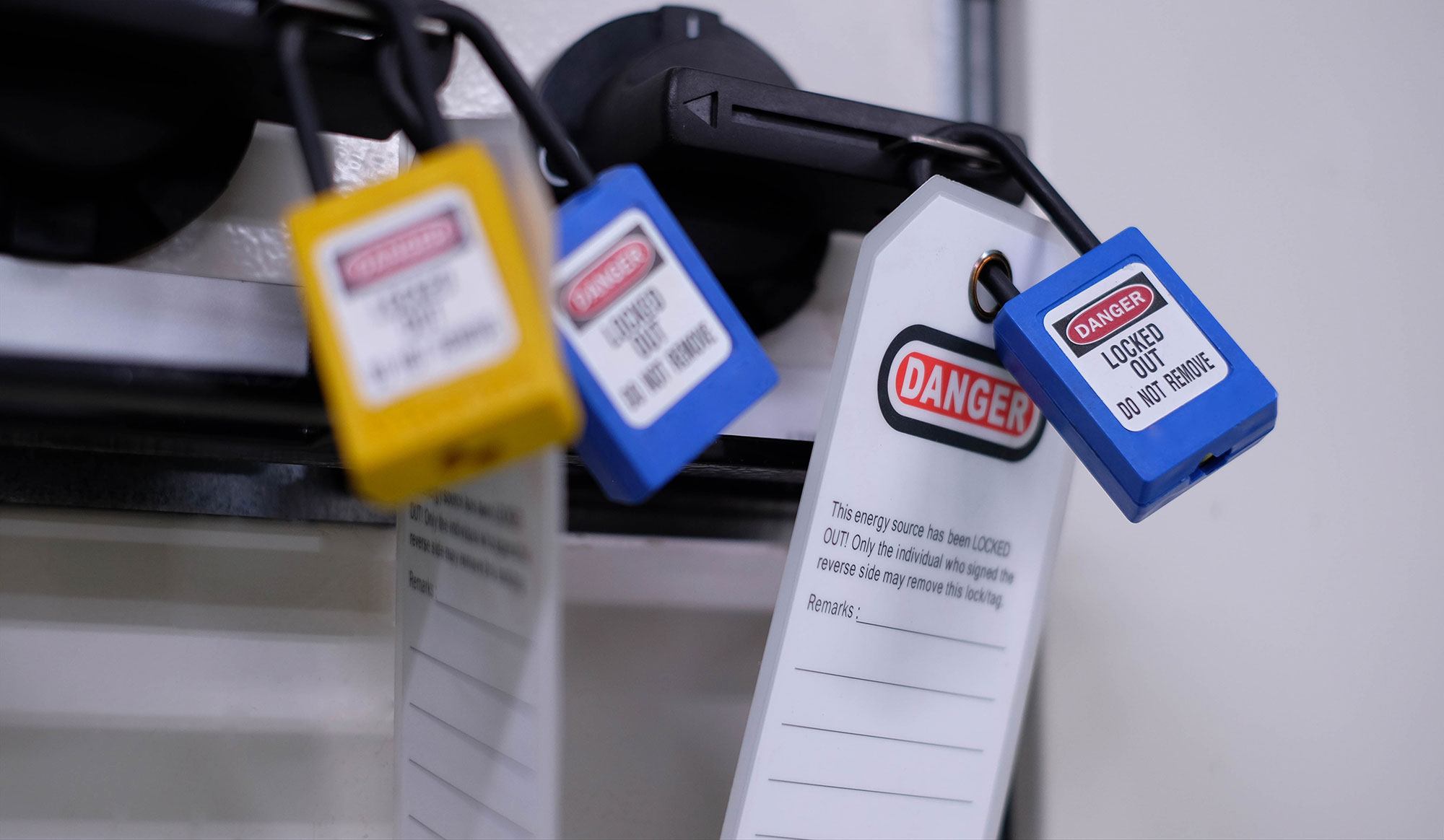
Guards come off for servicing, and that is the moment the risk multiplies. Lockout/tagout (1910.147) ranked No. 4 on OSHA’s FY2025 Top 10 with 2,562 violations, which tells you how often energy control breaks down during exactly this kind of work.
Two practices protect that window. First, employees must follow lockout/tagout procedures whenever machine guards are removed for maintenance or repairs. Second, someone must own guard reinstallation before the machine returns to service. A guard removed on second shift and never replaced is a hazard that outlives the repair, so build verification into your return-to-service step rather than leaving it to memory.
How often should you conduct machine safety training?
The OSHA rules are not very specific on the type and frequency of training for machine operation. Yet the consequences of machine accidents are severe enough that training should clearly be a top priority. At a minimum, training should take place:
- For new operators of existing machines
- For new types of machines introduced into the workplace
- Whenever there is evidence that an operator needs training
- At least annually, on a refresher basis
This training should include:
- Areas of the machine most likely to cause injury
- Description, purpose, and functions of machine guards
- Importance of ensuring that machine guards are in place and working properly
- Hazards of using machines
Document your training with employee names, dates, and type of training. Training records tied to named individuals and specific equipment are what demonstrate a functioning program when an inspector asks.
Employees must also report any problems with the operation of machine guards to their supervisor right away.
OSHA’s guidance on safeguarding and amputation prevention reinforces these elements, adding that only trained employees should operate machinery and that supervised on-the-job training is essential.
How often should you inspect machine guards?
Guards loosen, sensors drift out of alignment, and interlocks wear. A regular inspection cadence catches those conditions while they are still maintenance items. Consider building these checks into your existing routines:
- Operators verify guards are in place and functioning before each shift
- Supervisors confirm guard condition during walkthroughs
- Maintenance inspects interlocks, presence-sensing devices, and two-hand controls on a scheduled interval
- Any machine modification triggers a fresh look at whether the existing safeguarding still fits
Pair inspection with an open reporting culture. Employees who raise a loose guard early give you a maintenance ticket instead of an incident report, and the programs that hear about small problems first are the ones that avoid the large ones.
What are the fundamental rules of machine safety?
Each year employees die from machine-related injuries and thousands suffer nonfatal injuries, including amputations, lacerations, and crushing injuries. With this in mind, employees must always remember the two fundamental rules of machine safety:
- Always leave machine guards in place, and
- Always confirm a guard is present and working properly before using a machine
These two habits, practiced consistently, protect your people and your program at the same time.
Frequently asked questions
What does OSHA require for machine guarding?
OSHA requires guards against hazards created by the point of operation, ingoing nip points, rotating parts, flying chips, and sparks. Guards must protect machine operators and everyone else in the area. They must be secure and strong, and workers should not be able to bypass, remove, or tamper with them.
What are the four types of machine guards?
There are four basic kinds. Fixed guards include fences, gates, and protective covers. Interlocking guards disengage the machine’s power source when opened or removed. Adjustable guards provide a barrier that can be adjusted to many different operations. Self-adjusting guards move according to the size or position of the work piece.
How often is machine safety training required?
OSHA rules are not specific on frequency. At a minimum, train new operators of existing machines, train when new types of machines enter the workplace, train whenever there is evidence an operator needs it, and provide annual refresher training. Document training with employee names, dates, and type of training.
What is the penalty for a machine guarding violation?
For 2026, the maximum penalty is $16,550 per serious violation and $165,514 per willful or repeated violation. Penalties are assessed per violation, so a single walkthrough can generate several. Machine guarding ranked No. 10 on OSHA’s final Top 10 list for fiscal year 2025, with 1,498 violations.